
 咨询热线
咨询热线
0551-63492103
0551-63492022
 EMBA在线报名
 DBA在线报名
 后EMBA在线报名
AI时代如何重塑管理教育?执行院长叶强QS发表文章,探讨价值创造新范式
发布时间:2026-02-07 浏览次数:18
在全球聚焦AI技术突破的浪潮中,中国科学技术大学科技商学院、管理学院执行院长叶强教授在QS官方杂志《QS Insights》上发表前瞻文章:Management education’s reset in the age of AI。
文章指出,在技术日新月异的当下,聚焦于稳定框架的传统管理教育模式正面临深刻挑战。招生趋势的变化、大学使命的演进以及AI对组织架构的重塑,共同指向一个核心命题:管理教育的价值必须被重新定义。本文不仅是对全球管理教育未来的洞察,也清晰阐明了中国科大科技商学院、管理学院的创立初心与使命担当。
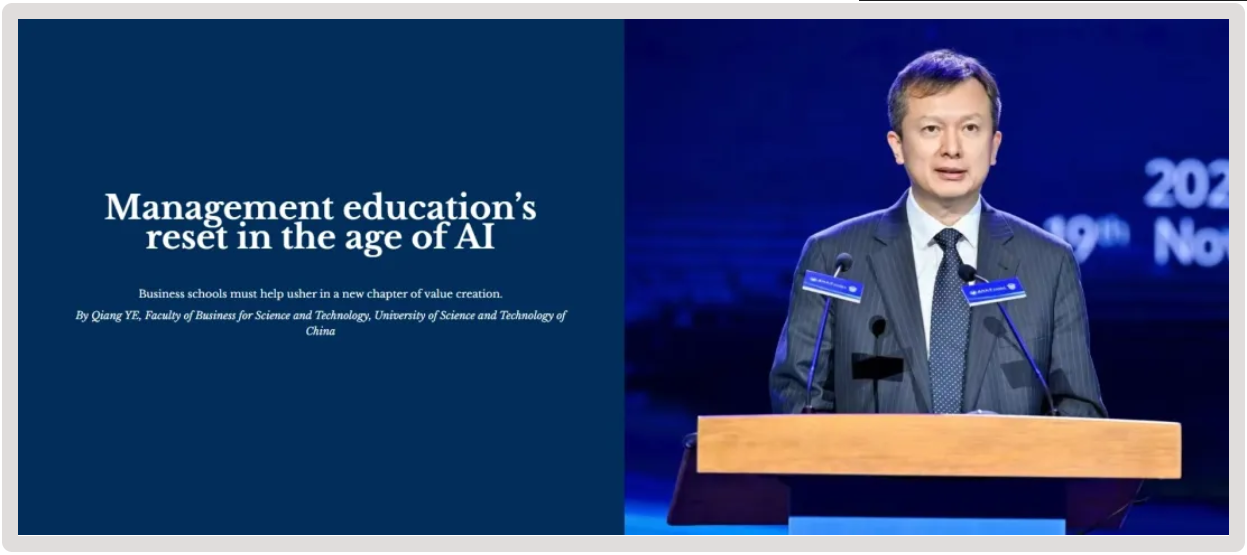
以下为文章原文,期待与各界同仁共同思考与探索。
As 2026 begins, conversations about artificial intelligence are often framed around dramatic technological breakthroughs or productivity gains. What I am keeping an eye on, however, is a quieter but more structural shift: how management education and management research are being redefined as AI reshapes how value is created, how organisations operate, and how universities engage with society.
Business schools remain vital to higher education systems worldwide. Yet they now face a renewed and sharpened question: what is business education for, in an era where technology increasingly mediates decision-making, coordination and even judgment? Over the next year, the answers institutions give, implicitly or explicitly, will matter.
Enrolment as a signal, not a verdict
Across many regions, business schools are encountering growing friction in recruitment, at the MBA and EMBA level and increasingly at the undergraduate level. Demographic shifts and changing employer expectations play a role, but one factor is particularly visible to students: the rapid advance of AI.
For many prospective learners, “future-proof” education is now associated with data science, computing, engineering and other STEM fields. By contrast, general management education is under closer scrutiny, especially as AI systems begin to automate or augment tasks that once defined early-career business roles, analysis, reporting, drafting, and even elements of strategy.
This does not mean management is becoming less important. Rather, it suggests that the traditional value proposition of business education, focused on stable frameworks and established practices, no longer speaks clearly to a world of accelerating technological change.
In 2026, I will be watching whether schools interpret enrolment pressure as a short-term marketing challenge, or as a deeper signal that curriculum design and research agendas must evolve.
The university’s three missions, and the next chapter for business schools
The second trend I’m watching is how universities redefine their role as “engines” of societal progress. Historically, we can roughly see three stages of modern university development:
The first stage, often represented by the University of Bologna and the University of Oxford et al, established the university’s first great mission: teaching and talent cultivation.
The second stage, associated with the University of Berlin (today Humboldt University), articulated the mission of scientific research as central to the university.
The third stage, exemplified by universities such as Wisconsin and later Stanford, elevated the mission of service to society, translating knowledge into social and economic progress.
Business schools, alongside law, medicine, engineering and other professional schools, have played an essential role in this third mission: forging leaders, strengthening institutions and bridging theory with practice. Looking ahead, I believe universities will move further toward becoming core nodes of social innovation, places where scientific discovery, technological invention, policy design and market creation interact at speed. In that future, the business school’s contribution is not peripheral but the central.
Why? Because the next chapter is not only about “more technology.” It is about value creation, how ideas become products, how labs become industries, how research becomes impact, and how organisations remain legitimate and responsible while scaling innovation. A “new-type research university” must integrate disciplines around real societal problems, and business schools are uniquely positioned to connect innovation with strategy, governance, finance, ethics, operations and entrepreneurship.
In 2026, I will be watching universities that move from excellence in separate silos to excellence in integrated value creation systems.
AI and the reconfiguration
of organisations
AI is not simply a new tool added to existing workflows; it is reshaping the internal architecture of organisations. Early signals suggest that AI can compress coordination layers, accelerate decision cycles and redefine what expertise means inside firms. Teams may become smaller yet more productive, and workflows may increasingly be organised around intelligent agents rather than purely human processes.
This creates a renewed agenda for management research and education. Classic concepts, capabilities, hierarchy, incentives, leadership and culture, remain relevant, but must be re-examined under new conditions. Questions of decision-making, accountability, talent development and ethics now look different when outcomes emerge from human–AI collaboration.
Technology-led development and the renewed importance of management
Around the world, governments are placing renewed emphasis on technology-driven industrial development. Strategic industries, resilient supply chains, productivity growth and innovation in areas from energy to advanced manufacturing have become national priorities.
Yet technological capability alone does not guarantee economic or social success. Scaling innovation depends on management: how organisations are designed, how ecosystems are governed, how uncertainty is hedged, and how responsibility and legitimacy are maintained. In this sense, AI and advanced technology increase, rather than reduce, the demand for sophisticated management knowledge.
In 2026, I will be watching which countries and institutions recognise that technology creates possibilities, but management converts possibilities into sustained productivity and societal value.
A response from China: USTC’s Faculty of Business for Science and Technology
At the University of Science and Technology of China (USTC), we are responding to these shifts by building a Faculty of Business for Science and Technology, a deliberate effort to innovate how business education and management research are conducted in a technology-driven era.
The guiding idea is straightforward: management education must be reconnected to the frontier of science and technology, and it must serve the real process of value creation, from discovery to deployment. That means closer integration with STEM disciplines, deeper engagement with industry and society, and a research agenda oriented to emerging organisational forms and innovation ecosystems. We aim to educate leaders who can speak both languages: the language of technology and the language of industry, capital, markets and management.
The year ahead will not deliver final answers about the future of management education. But it will provide clear signals. Enrolment trends, curricular choices, research priorities and institutional experiments will all indicate whether business schools are adapting to structural change, or merely reacting to it.
What I am keeping an eye on in 2026 is whether business schools treat this moment as a challenge to defend their past, or as an opportunity to redefine their future. The institutions that thrive will not compete with STEM disciplines. They will collaborate with them, helping societies turn technological potential into durable organisational capability and long-term value creation.
(转载自:中国科学技术大学科技商学院公众号)

 联系我们
联系我们
名称:中国科大EMBA中心(合肥)
电话:0551-63492103,0551-63492022
邮箱:embaxg@ustc.edu.cn
地址:合肥市滨湖新区中国科大国金院4栋4楼EMBA中心

扫一扫 关注微信公众号
Copyright 2020 中国科学技术大学EMBA All Rights Reserved 「 网站设计与制作维护:卫来科技 提供 」